Construction projects involve much more than designing attractive buildings. Behind every residential development, commercial property, industrial facility, and sports complex is a network of materials that determines how well the finished project performs over time.
Piping systems, drainage infrastructure, water distribution networks, and flooring surfaces may not always be the most visible parts of a building, but they are essential to its functionality. Choosing unsuitable materials can result in higher maintenance costs, installation difficulties, premature damage, or reduced comfort for occupants.
For this reason, contractors, developers, engineers, and property owners should evaluate construction materials based on their intended application rather than focusing only on initial purchase prices.
Different projects require different solutions. PVC pipes can be practical for many plumbing applications, while HDPE is often considered for infrastructure and water distribution systems. In buildings where noise control is important, acoustic drainage systems can provide additional benefits. Sports facilities, meanwhile, require flooring designed to withstand repeated movement and impact.
Understanding the characteristics of each material can make the procurement process more efficient and help project teams make better long-term decisions.
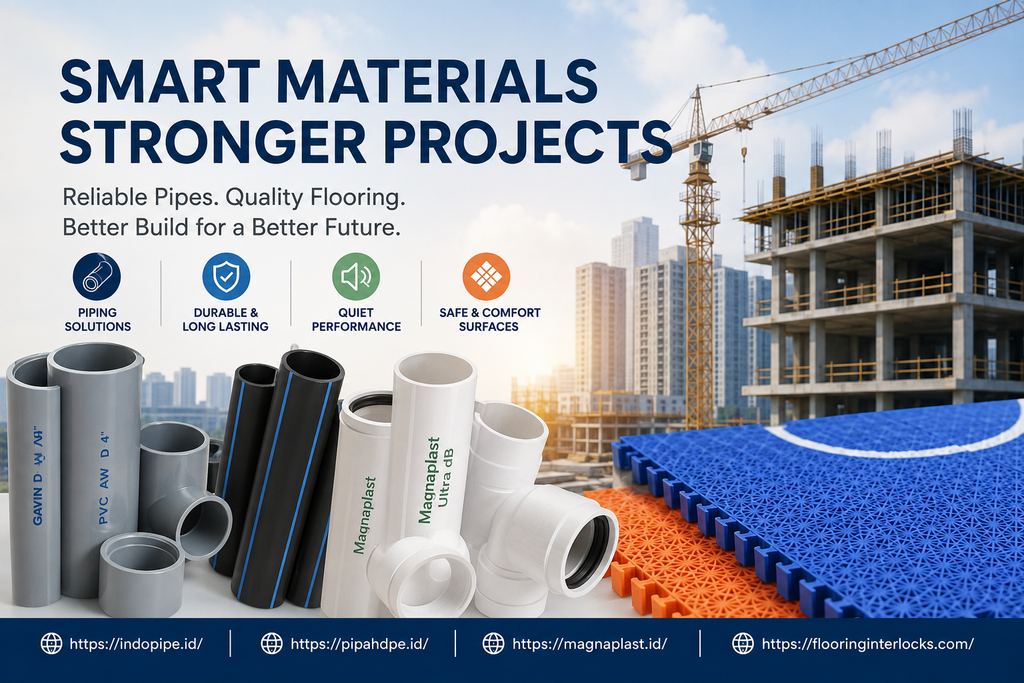
Understanding the Role of Materials in Construction
Every building system has a specific function. Water pipes transport clean water, drainage pipes remove wastewater, and flooring provides a surface for people and equipment to operate safely.
Because these systems perform different tasks, there is no single material that can be considered ideal for every application.
For example, a pipe installed inside a residential building may have different requirements from a pipeline used in an industrial facility. A drainage system in a hotel may also have different requirements from a basic residential installation because noise and occupant comfort can become more important.
Material selection should therefore begin with the project’s technical requirements.
Some of the factors that should be evaluated include:
- Intended application
- Operating pressure
- Temperature
- Chemical exposure
- Installation environment
- Required dimensions
- Expected service life
- Maintenance requirements
- Availability of fittings and accessories
- Transportation and installation costs
Taking these factors into account can help prevent common procurement mistakes and ensure that the selected materials are appropriate for the project.
PVC Pipes for Residential and Commercial Plumbing
PVC remains one of the most widely recognized materials for plumbing and utility applications. Its relatively lightweight construction makes it convenient to transport and handle, while its resistance to corrosion makes it suitable for environments where traditional metal pipes may require additional protection.
PVC pipes are commonly used in clean water systems, drainage, sanitation, and other utility installations. Different classifications are available for different pressure and application requirements.
One important consideration is the pipe wall thickness. A pressure water system requires a different pipe specification from a drainage application that operates without significant internal pressure.
Diameter also needs to be considered carefully. Undersized pipes can restrict water flow, while oversized systems may increase material costs unnecessarily.
For contractors looking for information about various piping products and applications, https://indopipe.id/ provides references for PVC, HDPE, PPR, acoustic piping, and other water-system products.
The site also presents Gavin PVC products in several sizes and classifications. Product selection should nevertheless be based on engineering requirements rather than simply choosing the largest or most economical option.
A properly selected PVC system can provide a practical solution when the product specification, installation method, and operating conditions are aligned.
Why HDPE Is Used in Infrastructure Projects
Infrastructure projects often face more demanding installation conditions than ordinary building plumbing.
Water distribution networks, irrigation systems, industrial pipelines, and underground utilities may require materials that can accommodate challenging site conditions. This is one reason High-Density Polyethylene, or HDPE, has become an important option for many infrastructure applications.
HDPE is known for its flexibility and resistance to corrosion. Unlike metallic pipes, it does not rust, which can be an important consideration for long-term water distribution systems.
Its flexibility can also make installation more practical in certain environments. Depending on the project design and product specifications, HDPE pipelines can be installed using different joining techniques, including fusion methods.
However, flexibility does not mean that every HDPE product is suitable for every application. Engineers should still consider pressure ratings, diameter, wall thickness, SDR, joining requirements, and site conditions.
For projects requiring HDPE products, https://pipahdpe.id/ offers information about HDPE solutions, including LESSO products for water distribution and infrastructure applications.
Proper installation remains essential. Fusion equipment, joint preparation, alignment, and testing should follow the relevant technical procedures to ensure the finished pipeline performs as expected.
Acoustic Performance in Modern Building Plumbing
Noise is another factor that is sometimes overlooked when designing plumbing systems.
Water flowing through drainage pipes can create vibration and sound. In a detached house, this may not be a major concern. However, the situation can be different in apartments, hotels, hospitals, offices, and other multi-story buildings.
When bedrooms, offices, or other occupied spaces are located close to drainage shafts, plumbing noise can affect the comfort of occupants.
Acoustic drainage systems are designed specifically for situations where noise reduction is an important consideration.
One example is the Magnaplast Ultra dB system. Information available from its distributor describes the system as a multilayer acoustic piping solution designed to reduce noise generated by drainage and wastewater flow. It is positioned for applications including apartments, hotels, hospitals, and high-end residential buildings.
More information about this type of acoustic piping solution can be found at https://magnaplast.id/.
However, installing an acoustic pipe alone does not automatically guarantee a quiet building. The overall construction system also matters.
Pipe supports, brackets, wall structures, connections, water velocity, and the method used to isolate pipes from structural elements can influence the amount of sound transferred through a building.
Therefore, acoustic performance should be considered as part of the overall building design rather than treated as a standalone product feature.
Selecting the Right Pipe for the Application
One of the most common mistakes in construction procurement is selecting materials based primarily on price.
While budget control is essential, the cheapest product may not always provide the best value over the entire service life of a project.
For example, a product that is difficult to install may increase labor costs. A material with unsuitable characteristics may require more frequent repairs. A system with difficult-to-source fittings could also create maintenance challenges in the future.
A better approach is to evaluate total project value.
For piping systems, this can include:
Material Cost
The initial purchase price is only one component of the overall cost. Quantity, fittings, accessories, transportation, and storage should also be considered.
Installation Cost
Some piping systems require specialized tools or equipment, while others may be installed using relatively simple methods. Installation requirements can significantly influence project labor costs.
Maintenance
Materials that are resistant to corrosion and chemical exposure may reduce certain maintenance requirements, depending on the application.
Service Life
Long-term durability is important for buried infrastructure and systems that would be expensive to replace after construction is completed.
Availability
A technically suitable product can become problematic if replacement parts or compatible fittings are difficult to obtain.
Considering these elements allows project managers to look beyond the initial quotation and assess the broader value of a material.
Flooring Requirements for Sports Facilities
Piping is only one part of a construction project. Sports facilities also depend on specialized materials that need to withstand demanding use.
Futsal courts, for example, experience frequent running, sudden stops, acceleration, turning, and changes in direction. The flooring therefore needs to provide an appropriate balance of durability, traction, comfort, and impact resistance.
Interlocking flooring has become an interesting option for certain sports applications because its modular construction allows individual pieces to connect together and form a continuous playing surface.
A modular system can offer practical advantages during installation and maintenance. If a particular section becomes damaged, the modular design may make localized replacement more manageable than replacing an entire floor, depending on the product and installation method.
For information about interlocking sports flooring and related applications, https://flooringinterlocks.com/ provides product information for futsal and other sports facilities.
The condition of the underlying surface should also be considered. A flooring system cannot compensate for a severely uneven or unsuitable subfloor. Proper preparation is therefore an important part of achieving good performance.
Installation Planning Should Start Early
Material selection and installation planning should not be treated as separate processes.
Before purchasing materials, project teams should understand how products will be transported, stored, cut, joined, installed, and tested.
For PVC systems, installers need to understand the appropriate connection methods and ensure that pipes receive adequate support.
For HDPE systems, fusion procedures and equipment preparation require particular attention. Poorly executed joints can compromise an otherwise suitable pipeline.
Acoustic drainage systems may require additional planning around pipe supports and structural interfaces to achieve their intended acoustic performance.
Sports flooring similarly requires attention to subfloor preparation, layout, expansion, installation sequence, and maintenance procedures.
Early planning helps prevent situations where a product is technically appropriate but difficult to install under actual site conditions.
Material Procurement for Large Projects
Large construction projects often involve purchasing thousands of meters of pipe and numerous fittings or flooring modules. Procurement mistakes at this scale can have significant consequences.
Project teams should establish clear technical specifications before requesting quotations.
A procurement document might include:
- Product type
- Diameter or dimensions
- Pressure rating
- Material specification
- Required quantity
- Fittings and accessories
- Applicable standards
- Delivery requirements
- Installation requirements
- Required documentation
Clear specifications make it easier to compare suppliers because quotations can be evaluated based on equivalent requirements rather than simply comparing prices.
It can also reduce the risk of receiving products that appear similar but have different technical characteristics.
The Importance of Technical Documentation
Product catalogs, technical datasheets, installation guides, and specifications can be valuable during construction planning.
For example, HDPE products can have different SDR and pressure classifications. PVC products may be available in different thickness categories. Acoustic pipe systems can have specific installation recommendations, while sports flooring can have particular requirements for the supporting surface.
Reviewing technical documentation before ordering materials allows engineers and contractors to verify whether a product is suitable for the intended application.
It also creates a useful reference for future maintenance teams.
When a building requires repairs several years after completion, knowing exactly which materials were installed can make replacement and maintenance much easier.
Looking Beyond the Initial Construction Phase
A successful project should be evaluated beyond the moment construction is completed.
Buildings and infrastructure systems may operate for decades. During that time, materials are exposed to water, temperature changes, pressure, chemicals, physical loads, and regular human activity.
This makes durability an important consideration during the design stage.
The most appropriate material is not necessarily the one with the highest price or the most advanced specifications. Instead, it should be the product whose characteristics match the actual conditions of the project.
A residential water system may benefit from a practical PVC solution. A large underground water network may require the flexibility and durability associated with HDPE. A high-end apartment or hotel may place greater emphasis on acoustic drainage performance. A futsal facility may require specialized modular flooring.
Each application has its own priorities.
Conclusion
Selecting construction materials requires more than comparing prices. Contractors, engineers, developers, and property owners need to understand how materials will perform under actual operating conditions.
PVC remains a practical option for many plumbing and utility applications, while HDPE can provide flexibility and corrosion resistance for infrastructure and water distribution. Acoustic drainage systems can address noise concerns in buildings where occupant comfort is important, while specialized interlocking flooring can support the demanding requirements of sports facilities.
The most effective approach is to match each material to its intended application, installation environment, maintenance requirements, and expected service life.
By combining careful specification, reliable sourcing, proper installation, and long-term planning, construction professionals can reduce unnecessary problems and create systems that remain functional for years.
Ultimately, good construction is not simply about choosing high-quality products. It is about choosing the right product for the right application, installing it correctly, and maintaining it according to its intended use.
That principle applies equally to a small residential plumbing project, a large infrastructure network, a multi-story commercial building, or a specialized sports facility.